
Energy & Money Saving Tips
Efficiency Maine offers tips to become more energy efficient and financial incentives (such as rebates, instant discounts, and loans) that can make upgrading to a high-efficiency system more affordable.
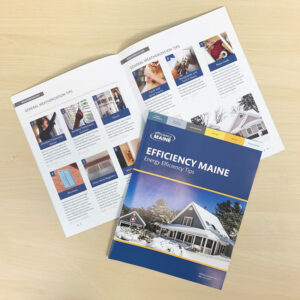 Our Energy Efficiency Tips booklet offers a wide selection of suggestions on how to improve the energy efficiency of your home. To download a copy click here. To request a printed copy, email info@efficiencymaine.com or call 866-376-2463.
Here are some useful tips on how to save energy at home this fall and winter.
Make sure your boiler or furnace is cleaned and serviced annually by qualified personnel for optimum efficiency. Cleaning makes the heating system safer and much more efficient and makes it last longer.
Spray foam insulation and caulk are often used to fill cracks and gaps where air could travel between outdoors and indoors. To make a room warmer in winter and cooler in summer, try air sealing with caulk, spray foam, or both.
If replacing your doors, apply caulking around door frames and weather stripping around doors that do not close tightly. If replacing your sliding door, select ENERGY STAR®-certified models.
Install door sweeps to keep out hot air in summer and cold drafts in winter.
If you have a hydronic (often referred to as “forced hot water”) heating system and have to replace circulator pumps, consider Electrically Commutated Motor (ECM) pumps, which can reduce operating cost by 85% because their motors adjust their speed to match the load. They also tend to be more reliable than traditional circulator pumps.
Properly close the flue damper of your fireplace when not in use. This will not only prevent warm indoor air from escaping in winter but also keep in cool air in the summer. Make sure that any fire is totally out before closing down the damper of your fireplace and also confirm there are no glowing embers. Doing so could help prevent your room or home from being filled with carbon monoxide and other pollutants.
1. Use your heat pumps all winter. If you have both heat pumps and a boiler or furnace, your heat pumps are the more energy-efficient choice.
2. Set it and forget it. Turning heat pumps down when you’re away or asleep may actually use more energy than leaving them on.
3. Use different “Heat” and “Cool” settings in winter and summer, respectively, rather than “Auto Temperature” mode.
4. Start with the fan speed set to “auto.” If that doesn’t spread the heated or cooled air far enough, select the fixed speed that works best for you.
5. For maximum efficiency, vacuum or rinse indoor unit filters regularly to make sure that air flows freely.
See all of our Heat Pump User Tips here.
If you do not have a heat pump, consider turning down your furnace or boiler thermostat to 55 degrees when your home is unoccupied. For sleeping, consider setting your thermostat to 60 degrees.
Programmable thermostats run automatically and can adjust the temperature on their own based on the time of day or day of the week. This can help your home use less energy when it is unoccupied or at night while you sleep.
If your home has radiators, place heat-resistant reflectors between radiators and walls to heat the room instead of the wall.
Seal outlets and switch boxes with foam gaskets to reduce drafts and create a barrier between warmer and cooler air.
You can improve your home’s energy efficiency by making sure that vents and floor registers are well sealed where they meet with the wall or floor. Make sure all ducts are connected and all vents and floor registers are clear of furniture or rugs that could impede airflow.
Consider installing a temporary seal around rarely used windows and doors, such as a basement door that is unused in the winter. Many types of rope caulk can be easily removed in the spring, stored in a plastic bag, and reused.
Compared to conventional thermostats, smart thermostats are more accessible and more convenient. Some smart thermostats can detect your presence in a room and can adjust the temperature accordingly. They can be controlled via any smartphone, so you can turn the temperature up or down as you return home.
Use weather stripping for doors and windows to keep out hot air in summer and cold drafts in winter.
Insulating windows around their edges makes your home even more energy efficient. To reduce heat loss in winter, install storm windows, transparent plastic window film, or indoor window inserts. When purchasing windows, look for ENERGY STAR®-certified models designed for Maine’s climate.
During winter days, let sunlight in by opening curtains, blinds, and shades on windows facing the sun to reduce heating demand. At night, keep drapes and curtains closed to reduce heat loss.
Use only the heat needed — if your home has zone heating, be sure to heat only the smallest zone possible. If you are using one zone, consider turning down thermostats and closing registers in vacant zones, taking precautions to avoid frozen pipes.